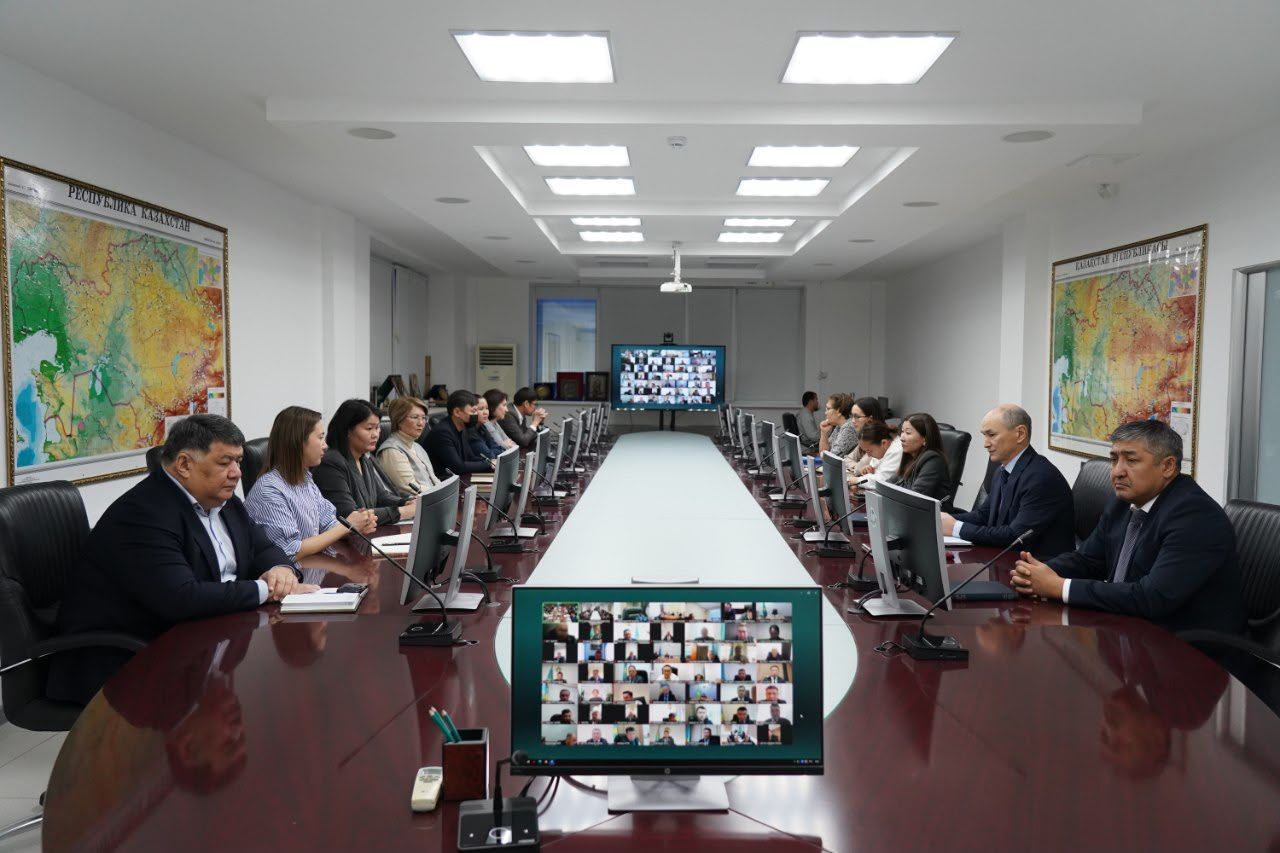
Today, Minister of Ecology and Natural Resources of the Republic of Kazakhstan Alibek Kuantyrov held an expanded meeting on anti-corruption efforts within the Ministry's system.
The meeting was attended by heads and responsible staff of the Ministry's departments, structural and territorial divisions, subordinate organizations, as well as compliance officers.
The meeting addressed the current state of anti-corruption efforts, the results of identified violations, the effectiveness of internal control mechanisms, and measures to prevent corruption risks across the Ministry's departments and subordinate organizations.
Opening the meeting, the Minister emphasized that the principle of "Law and Order" must serve as an unconditional guiding principle for every civil servant. Compliance with legislation, official discipline and integrity are mandatory requirements of public service, regardless of one's position, length of service or personal connections.
"Such an attitude towards public service is unacceptable within our Ministry. Neither one's position, length of service nor personal relationships give anyone the right to disregard the law," Alibek Kuantyrov stressed.
Particular attention was paid to corruption risks in the areas of environmental regulation and control, project implementation, forestry and wildlife management, permit issuance and budgetary procedures.
During the meeting, reports were delivered by Ganiyzhan Asanuly, Head of the Ministry's Office; Yerbolat Kozhikov, Chairman of the Committee for Environmental Regulation and Control; and Daniyar Turgambayev, Chairman of the Committee for Forestry and Wildlife.
Following the discussion, the Minister instructed to strengthen departmental oversight of the legality of officials' actions in carrying out permitting and supervisory functions.
In addition, the following instructions were issued:
▪️ conduct a thorough internal assessment of corruption risks;
▪️ strengthen the work of compliance services in quasi-public sector organizations;
▪️ optimize and automate business processes that are most vulnerable to corruption risks;
▪️ eliminate direct contact with citizens and businesses when performing permitting and supervisory functions;
▪️ ensure regular anti-corruption training for employees;
▪️ ensure staff rotation for employees who have held the same positions for an extended period.
The Minister placed particular emphasis on the personal responsibility of managers for fostering an anti-corruption culture within their teams.
"Every manager must be personally responsible for the state of anti-corruption efforts in their respective unit, understand where risks exist, respond promptly to warning signs and prevent violations," he emphasized.
In conclusion, the Minister noted that corruption prevention requires consistent and systematic efforts. The personal example set by every manager is of particular importance. Upholding the principle of "Law and Order", maintaining zero tolerance for corruption and ensuring transparency in public service delivery procedures remain essential conditions for the effective operation of the Ministry.